

 |
Ammonia Synthesis Gas CO2 Removal Sphelite ASD-35 Macroporous Primary Amine Resin
Product Details:
| Place of Origin: | China |
| Brand Name: | SPHLITE |
| Model Number: | ASD-35 |
Payment & Shipping Terms:
| Minimum Order Quantity: | 1 Ton |
|---|---|
| Price: | Negotiable |
| Packaging Details: | 25 kg/bag, 40 bags = 1 ton on pallet (custom packaging available) |
| Delivery Time: | 10 working days after payment |
| Payment Terms: | T/T, L/C |
| Supply Ability: | 24000 Tons per Year |
|
Detail Information |
|||
| Application: | Ammonia Synthesis Gas CO2 Removal | Typical Feed CO2 Content: | 18-30 % In Shifted Syngas |
|---|---|---|---|
| Downstream Duty: | Methanation And Ammonia Converter Protection | Regeneration: | Low Temperature Steam Stripping |
| Appearance: | Maple Opaque Spherical Beads | Matrix: | Crosslinked Polystyrene, Macroporous |
| Functional Group: | Primary Amine | Particle Size Range: | 0.35-1.20 Mm |
| Moisture Content: | 58 +/- 5 % | Shipping Weight: | 0.68 +/- 0.05 G/ml |
| Coefficient Uniformity: | <= 1.5 | Temperature Resistance: | 100 C |
| Toxicity: | Harmless | Packing: | 25 Kg/bag, 40 Bags = 1 Ton Per Pallet |
| Highlight: | Ammonia Synthesis CO2 Removal Resin,Syngas Purification Amine Resin,Macroporous Crosslinked Polystyrene Beads |
||
Product Description
Sphelite ASD-35 Primary Amine Resin for Ammonia Synthesis Gas CO2 Removal
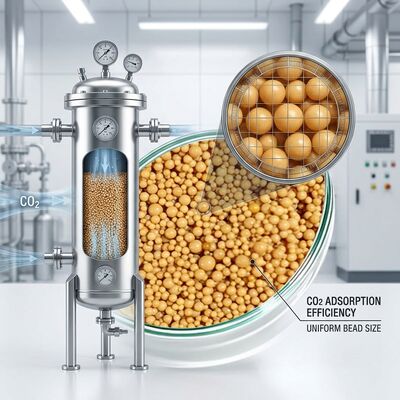
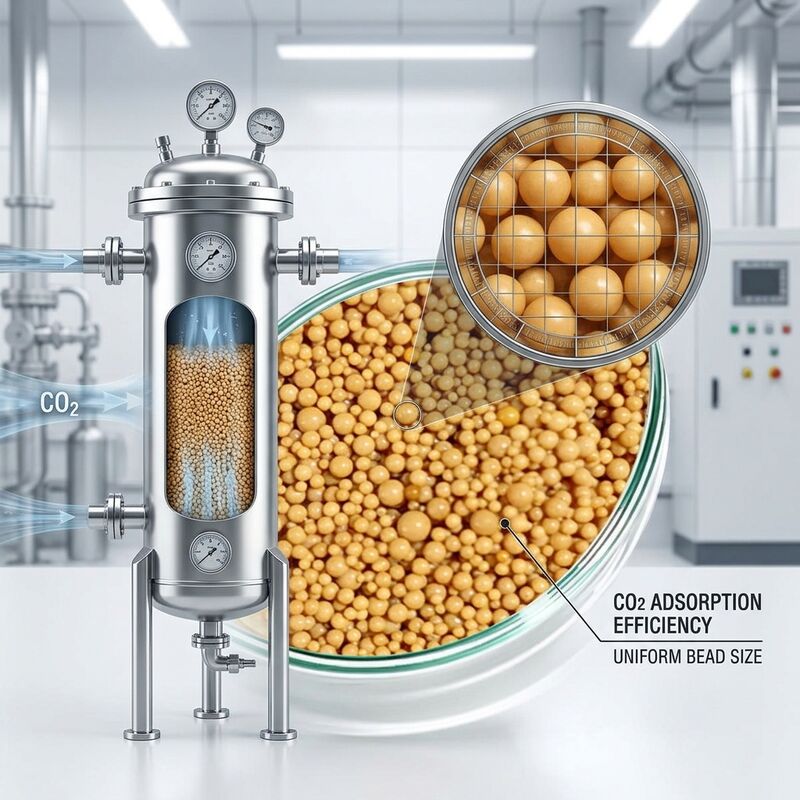
In an ammonia plant the shifted syngas leaving the CO shift section still carries 18-30 % CO2. That CO2 has to be removed before methanation and the ammonia converter, and every point of residual CO2 costs catalyst life. Sphelite ASD-35 is a macroporous primary amine resin on a crosslinked polystyrene matrix that removes CO2 from syngas by chemical adsorption, giving a dry, solvent free alternative or polishing step for the traditional amine wash.
Application Scope
ASD-35 is used for CO2 polishing downstream of a bulk Benfield or MDEA wash, for CO2 removal on small and mid scale ammonia and urea units where a full solvent loop is uneconomic, and for syngas conditioning in methanol and hydrogen plants that share the same shifted gas route. It also protects methanation and ammonia synthesis catalysts from CO2 slip during upsets.
Typical Technical Parameters
| Typical CO2 Load | 18-30 % in shifted syngas, polishing to low ppm levels |
| Gas Conditions | Cooled and de sulphurised before the bed |
| Regeneration | Low temperature steam stripping |
| Appearance | Maple opaque spherical beads |
| Matrix | Crosslinked polystyrene, macroporous |
| Functional Group | Primary amine |
| Particle Size Range (mm) | 0.35-1.20 |
| Moisture Content (%) | 58 ± 5 |
| Shipping Weight (g/ml) | 0.68 ± 0.05 |
| Coefficient Uniformity (≤) | 1.5 |
| Temperature Resistance | 100 °C |
| Toxicity | Harmless |
Why ASD-35 Performs Here
Protects synthesis catalysts
Chemical adsorption on the primary amine group holds CO2 tightly enough to polish syngas to very low residual levels, so the methanation reactor and ammonia converter see a stable, low CO2 feed.
Lower regeneration duty
Desorption takes place at a temperature below the reboiler duty of a conventional amine wash, which frees steam for the ammonia synthesis loop and reduces the plant energy penalty.
Clean operation
A solid resin carries no solvent inventory, so there is no amine degradation, no foaming in the absorber and no corrosion inhibitor dosing to manage.
Mechanically robust
Uniform spherical beads with high crush strength survive deep beds and repeated steam regeneration, keeping pressure drop predictable over the campaign.
Packing, Delivery & Service
Standard export packing is 25 kg per bag, 40 bags (1 ton) per pallet, with custom drum or big bag packing available on request. Lead time is about 10 working days after payment, and our technical team supports loading calculations, pressure drop estimates and pilot column trials before you scale up.
FAQ
Q1. Can ASD-35 replace a full amine wash?
A: For small and mid scale units it can act as the main CO2 removal step. On large ammonia trains it is most often used as a polishing bed downstream of the bulk wash, which is where solvent systems struggle to reach low residual CO2.
Q2. What gas pretreatment is required?
A: Cool the syngas and remove sulphur compounds and any entrained liquid before the bed. If your gas carries carbonyl sulphide or mercaptans, tell us and we will advise on a guard layer.
Q3. Do you supply loading calculations?
A: Yes. Provide the syngas flow, CO2 concentration, pressure, temperature and target residual CO2, and our engineers return bed volume, cycle time and steam demand estimates.
Specifications above are typical values from routine production and can be adjusted to meet a specific project requirement. Please confirm the working conditions with our technical team before ordering.
